Engineering leadership brief

Stephen Courtier

Senior / Staff Software Engineer

Engineering leadership for ambiguous systems, platform leverage, and calm delivery.

I help product and engineering teams turn unclear technical terrain into crisp architecture, reliable delivery, and teams that can move with confidence.

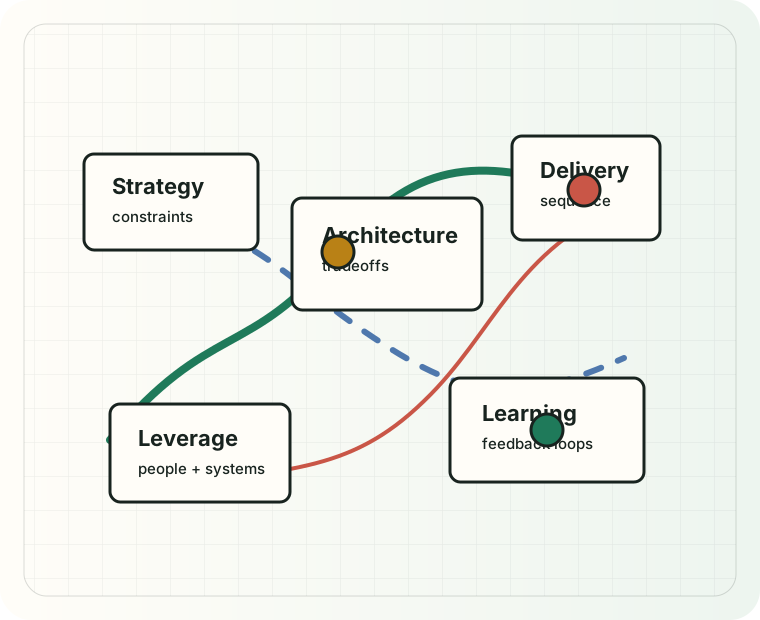
Abstract systems map showing strategy, architecture, delivery, and learning loops.
Ambiguity converted into decision paths, ownership, and operating leverage.
Staff+
technical scope
0 -> 1
ambiguous bets
DX
developer leverage
Ops
production calm

Best-fit problems

Where Stephen creates executive-level engineering signal fastest.

The page is built for hiring teams who need to understand the shape of Stephen's judgment before the first conversation.

Current signal

When the business knows the outcome, but the technical path is still foggy.

Stephen is strongest where product, platform, architecture, and delivery are tangled together and the team needs a usable path through the ambiguity.

  • Shape options and tradeoffs
  • Name risks before they become schedule debt
  • Turn strategy into executable slices

Operating system

A simple model for senior technical leverage.

01

Clarify the terrain

Turn noisy context into constraints, stakeholders, risks, non-goals, and decision points.

02

Shape the architecture

Design the smallest durable structure that can carry the product, team, and operational load.

03

Land the change

Sequence migrations, delivery slices, ownership shifts, and rollout plans so progress is observable.

04

Compound the learning

Leave behind decisions, playbooks, dashboards, and rituals that make the next hard thing easier.

Proof surface

Everything important should be clickable.

Public proof is deliberately separated from inferred positioning. The site points hiring teams at the available public surfaces without inventing private LinkedIn details.

Decision artifacts

What great engineering leadership leaves behind.

Interview lens

How expert hiring teams should evaluate Stephen.

  1. Give Stephen a vague platform bet and ask him to create the first two-week learning slice.
  2. Ask for the tradeoffs between speed, reliability, observability, and team ownership.
  3. Ask how he would make an incident review useful to product leadership.
  4. Ask what artifact he would create first when architecture direction is contested.
  5. Ask how he raises engineering quality without turning reviews into gatekeeping.

Contact

Start with the hardest problem on the table.

Send the ambiguous bet, the reliability concern, the platform constraint, or the leadership gap. The fastest way to evaluate Stephen is to put real context in the room.